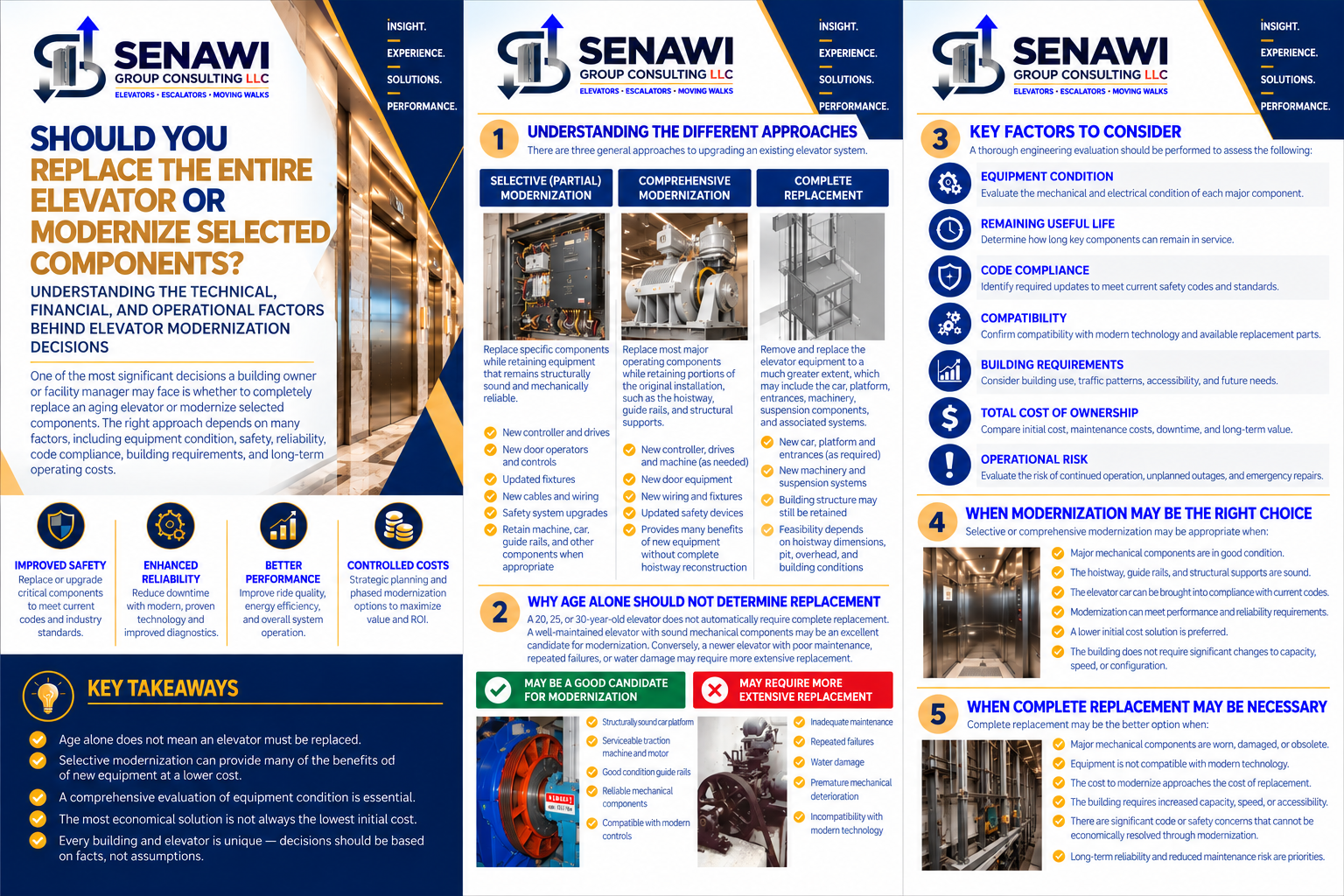
SHOULD YOU REPLACE THE ENTIRE ELEVATOR OR MODERNIZE SELECTED COMPONENTS?
UNDERSTANDING THE TECHNICAL, FINANCIAL, AND OPERATIONAL FACTORS BEHIND ELEVATOR MODERNIZATION DECISIONS
Senawi Group Consulting LLC Independent Elevator, Escalator & Moving Walk Consulting
Introduction
One of the most significant decisions a building owner or facility manager may face is determining whether an aging elevator should be completely replaced or whether modernization of selected components can provide a reliable, cost-effective solution.
Elevator modernization projects represent substantial capital investments, often involving hundreds of thousands of dollars per elevator. Depending on the building, equipment type, project complexity, and number of elevators, costs can vary considerably.
Unfortunately, owners are sometimes presented with modernization proposals that recommend replacing nearly every major component without a sufficiently detailed explanation of why each replacement is necessary.
In other cases, contractors recommend limited equipment upgrades that may reduce initial costs but fail to address underlying mechanical deterioration, equipment incompatibility, or future maintenance concerns.
The most economical solution is not necessarily the least expensive proposal, nor is complete equipment replacement always the best long-term investment.
A sound modernization strategy should begin with a comprehensive engineering evaluation of the existing equipment, its condition, reliability, remaining useful life, and compatibility with modern technology.
1. Understanding the Difference Between Modernization and Complete Replacement
Selective or Partial Modernization
Selective modernization involves replacing specific elevator components while retaining equipment that remains structurally sound, mechanically reliable, and technically compatible with the proposed upgrades.
Depending on the elevator's condition, a partial modernization may include:
For many conventional traction elevators, selected components can remain serviceable for years beyond the practical life of the original control system.
However, retained equipment must be evaluated for mechanical condition, code compliance, compatibility, and remaining service life.
Comprehensive Modernization
A comprehensive modernization typically involves replacing most major operating components while retaining portions of the original installation, such as the hoistway, guide rails, structural supports, and sometimes the car platform or entrances.
It may include new controllers, drives, traction machines, motors, suspension systems, door equipment, wiring, fixtures, and applicable safety devices.
This approach can provide many of the operational benefits associated with new equipment without requiring the demolition and reconstruction associated with a completely new elevator installation.
Complete Elevator Replacement
Complete replacement involves removing and replacing the elevator equipment to a much greater extent, potentially including the car, platform, entrances, machinery, suspension components, and associated systems.
Depending on existing building conditions, some structural and hoistway elements may still be retained.
It is important to recognize that a complete elevator replacement does not necessarily mean reconstructing the entire hoistway.
In existing buildings, structural conditions, shaft dimensions, pit depth, overhead clearance, and building configuration may significantly affect what can be replaced and which new elevator technologies are feasible.
2. Why Elevator Age Alone Should Not Determine Replacement
A common misconception is that an elevator reaching 20, 25, or 30 years of age automatically requires complete replacement.
Although age is an important consideration, it is only one factor in determining equipment condition and remaining useful life.
A well-maintained traction elevator with a robust machine, structurally sound car platform, serviceable guide rails, and properly maintained mechanical equipment may be an excellent candidate for selective modernization.
Conversely, a considerably newer elevator that has experienced inadequate maintenance, repeated failures, water damage, or premature mechanical deterioration may require more extensive replacement.
The evaluation should consider:
Equipment condition: The actual mechanical and electrical condition of each major component.
Maintenance history: The frequency of repairs, callbacks, shutdowns, and recurring deficiencies.
Parts availability: Whether critical components remain commercially available and can be supported by qualified service providers.
Operating performance: Ride quality, leveling accuracy, door operation, noise, vibration, and overall reliability.
Remaining useful life: Whether retained equipment is likely to provide satisfactory service throughout the intended modernization investment period.
Code compliance: The extent to which proposed alterations trigger additional safety or building-code requirements.
Future maintainability: Whether the proposed system can be serviced without unnecessary dependence on proprietary equipment, software, or specialized tools.
The objective is to determine which components have reached the end of their practical service life and which can reasonably be retained.
3. Evaluating the Major Elevator Components
A comprehensive modernization assessment should examine the major systems individually rather than treating the elevator as one piece of equipment.
A. Elevator Controllers and Operating Systems
Older elevator controllers are frequently among the first major systems considered for replacement.
Obsolete controllers may contain discontinued circuit boards, aging relays, unavailable electronic components, or software systems that are no longer supported.
Warning signs include repeated unexplained shutdowns, difficulty obtaining replacement components, poor diagnostic capabilities, and dependence on a limited number of technicians.
Replacing the controller can significantly improve reliability, troubleshooting, operating performance, and future maintenance options.
Technical consideration: A new controller must be properly integrated with the retained traction machine, motor, brake, door system, position feedback, safety circuits, and other equipment.
Controller replacement alone will not correct worn bearings, deteriorated brakes, damaged sheaves, or other mechanical deficiencies.
B. Traction Machines and Motors
The traction machine is often one of the most expensive components involved in a modernization.
Older geared and gearless machines may remain suitable for continued operation if they are in satisfactory mechanical condition.
A proper evaluation should include:
For older direct-current machines, the assessment should also consider the motor-generator arrangement, armature condition, commutator, brushes, and feasibility of converting to modern control technology.
An older machine should not automatically be replaced because of its age. However, a machine should not be retained solely to reduce modernization costs if its condition or compatibility presents unacceptable risk.
C. Elevator Door Equipment
Door equipment is one of the most frequent sources of elevator service calls and operational problems.
The evaluation should address the car door operator, clutch, hoistway door interlocks, door hangers, rollers, tracks, closers, restrictors, and associated mechanical components.
An elevator with a reliable traction machine and controller may still experience frequent shutdowns because of worn or poorly adjusted door equipment.
In many cases, door system modernization provides substantial improvements in reliability and passenger experience.
However, replacing only the door operator while retaining badly worn hoistway door equipment may leave the primary cause of failures unresolved.
D. Elevator Car, Platform, and Entrances
Elevator cars, platforms, and hoistway entrances can often be retained during modernization, subject to structural and code considerations.
The assessment should include structural integrity, corrosion, damage, car frame condition, platform condition, guide shoe or roller guide assemblies, entrance clearances, and existing loading requirements.
Car interior refurbishment can be considered separately from the modernization of operating equipment.
Owners should understand that replacing decorative finishes does not necessarily improve elevator reliability or mechanical performance.
E. Suspension Ropes, Sheaves, and Counterweight Systems
Suspension components require careful evaluation because of their direct relationship to elevator safety.
The assessment should include suspension rope condition, diameter reduction, corrosion, broken wires, tension, equalization, sheave groove wear, rope terminations, and counterweight condition.
Depending on the installation, compensation ropes or chains and their associated equipment may also require evaluation.
The modernization scope should consider whether the retained suspension system remains compatible with proposed changes to machine characteristics, car weight, rated load, or operating speed.
F. Safety Equipment
The evaluation should include applicable governors, car safeties, buffers, brakes, door interlocks, unintended car movement protection, ascending car overspeed protection, and related monitoring systems.
A proposed modernization may require modifications to existing safety systems depending on the adopted code, scope of alteration, and equipment configuration.
Importantly, different safety systems address different failure modes.
For example, a rope-gripping device may address certain unintended movement scenarios but should not be assumed to provide protection against complete suspension failure.
Safety-device selection must be based on the actual hazards, equipment arrangement, applicable code, and verified system compatibility.
4. When Selective Modernization Makes Financial Sense
Selective modernization may provide excellent long-term value when the existing elevator has:
Consider a traction elevator with an obsolete controller but a well-maintained gearless machine.
Replacing the controller, drive, wiring, fixtures, and selected door components may provide substantial improvements without the expense of replacing a serviceable machine.
However, the engineering evaluation must establish that the retained machine and associated equipment are suitable for the anticipated operating life of the modernization.
5. When Comprehensive Modernization or Replacement Is More Appropriate
More extensive replacement should be considered when major mechanical systems have deteriorated or when the existing installation cannot reasonably meet the building's operational requirements.
Conditions that may support comprehensive modernization or replacement include:
Significant machine deterioration: Excessive gear wear, damaged shafts, deteriorated bearings, severe vibration, or repeated brake deficiencies.
Multiple obsolete systems: Controllers, drives, motors, and safety components that can no longer be reliably supported.
Poor equipment compatibility: Existing machinery or operating systems that cannot be safely and economically integrated with modern equipment.
Extensive corrosion or damage: Water exposure, fire damage, structural deterioration, or other conditions affecting equipment integrity.
Changed building requirements: Increased traffic demand, different occupancy, accessibility improvements, or revised operational needs.
Unacceptable long-term maintenance risk: Continued dependence on difficult-to-obtain parts, limited service support, or aging equipment with uncertain remaining life.
Excessive lifecycle cost: A partial modernization that would likely require additional major replacements shortly after project completion.
In these circumstances, replacing more equipment initially may produce better long-term value.
6. The Hidden Risk of Combining New Technology With Aging Equipment
One of the most important considerations in selective modernization is the integration of new electrical controls with older mechanical equipment.
A new controller and drive may operate differently from the original system.
Changes in acceleration, deceleration, torque characteristics, braking performance, or operating duty may expose existing mechanical deficiencies.
For example, retaining an older traction machine while installing a modern drive requires careful evaluation of motor characteristics, feedback systems, brake operation, traction capability, and operating performance.
Similarly, a new door operator may not perform reliably if the existing hoistway door tracks, hangers, rollers, or interlocks are worn.
The success of a partial modernization depends on the compatibility and condition of the entire retained system—not simply the quality of the newly installed components.
7. Understanding the True Cost of Elevator Modernization
Building owners should evaluate modernization proposals using total lifecycle cost rather than initial installation cost alone.
The following hypothetical example illustrates why the least expensive initial proposal may not provide the best value.
COST CONSIDERATION SELECTIVE MODERNIZATION COMPREHENSIVE MODERNIZATION
Initial capital
investment Generally lower Generally higher
Retained equipment More existing components Fewer existing components
Potential future
repairs Depends heavily on retained condition Often reduced for replaced systems
Equipment
compatibility Requires careful integration May be easier with matched systems
Project duration May be shorter May be longer
Long-term
maintenance Depends on selected equipment Depends on selected equipment
Future capital needs May occur sooner May be deferred
Neither approach is universally superior.
A proper comparison should consider projected maintenance expenses, future major repairs, parts availability, downtime, energy consumption, warranty coverage, and anticipated equipment service life.
An owner who saves money today by retaining a deteriorated traction machine may face a significant additional capital expense several years later.
Conversely, replacing a mechanically sound machine without a documented engineering justification may represent an unnecessary expenditure.
8. The Importance of Independent Modernization Specifications
Elevator contractors may propose different equipment packages based on the manufacturers they represent, their preferred technology, and the scope they are prepared to install.
One contractor may recommend replacing the traction machine, while another may propose retaining it.
A third contractor may recommend a different controller, door system, or suspension arrangement.
Without a consistent technical specification, building owners may find themselves comparing proposals that differ substantially in equipment, performance, safety provisions, warranties, and exclusions.
An independent modernization specification establishes a common basis for competitive bidding.
It should identify:
This approach helps owners compare proposals more accurately and reduces the risk of omissions, unexpected change orders, and disputes during construction.
9. Questions Every Building Owner Should Ask Before Approving a Modernization
Before committing to a major elevator modernization, building owners should ask:
1. Has a comprehensive mechanical and electrical equipment assessment been performed?
2. Which existing components are actually defective, obsolete, or approaching the end of their useful life?
3. What technical evidence supports the recommendation to replace each major component?
4. Can the existing traction machine be safely retained?
5. Are the proposed controller and drive compatible with retained equipment?
6. What safety upgrades will be required by the applicable codes and the proposed alteration scope?
7. Will the equipment be maintainable by qualified contractors other than the installing company?
8. What major repairs could reasonably be anticipated within the next five to ten years?
9. Are the contractor proposals based on equivalent specifications and performance requirements?
10. Has the lifecycle cost of partial modernization been compared with comprehensive modernization?
Owners should request written answers and supporting technical documentation rather than relying exclusively on verbal recommendations.
10. Why an Independent Elevator Assessment Should Come First
An independent elevator consultant can evaluate the existing installation before modernization decisions are influenced by equipment sales proposals.
The assessment can help identify which components require replacement, which may remain serviceable, and where additional investigation is necessary.
It can also assist with developing an appropriate modernization scope, preparing technical specifications, evaluating competitive bids, coordinating construction, and witnessing acceptance testing.
For buildings with multiple elevators, an independent assessment can support phased modernization strategies that balance capital expenditure with the need to maintain elevator service.
The goal is not to recommend the largest modernization project.
The goal is to identify the appropriate technical solution that delivers reliable performance, reasonable long-term maintenance costs, and the required level of safety.
Conclusion: Replace What Is Necessary, Retain What Is Practical
Elevator modernization should never be approached as a simple choice between keeping everything and replacing everything.
Each installation has unique mechanical, electrical, structural, operational, and financial characteristics.
A properly maintained elevator may contain components capable of providing many additional years of reliable service. Other components may be obsolete, deteriorated, or incompatible with modern technology and should be replaced.
The most effective modernization strategy is developed through a detailed engineering evaluation that considers equipment condition, code requirements, future maintenance, compatibility, operating performance, and lifecycle cost.
Building owners should not approve a major elevator modernization solely because a contractor recommends replacing the equipment. The recommendation should be supported by documented technical findings and a clear explanation of the expected benefits.
A Note to Building Owners and Facility Managers
Before committing to selective or complete elevator modernization, ask detailed questions and consider engaging a qualified, independent elevator consultant to assist with the evaluation and decision-making process.
Modernization projects can involve complex interfaces between new technology and existing equipment. Inadequate assessments, incomplete specifications, and poorly coordinated installations can lead to unexpected costs, persistent operating problems, and systems that fail to perform as intended.
An independent assessment before committing to a major capital expenditure can help protect your investment and support better long-term decisions.
Karl Senawi, Ph.D. President
Senawi Group Consulting LLC Email: senawik@senawiconsulting.com Phone: 248-763-7300
Technical advisory: This article provides general guidance. Modernization requirements and equipment suitability must be established through project-specific evaluation, manufacturer documentation, applicable codes, and the authority having jurisdiction.
Elevators. Escalators. Moving Walks.
ELEVATING PERFORMANCE. DELIVERING SOLUTIONS.