HOW LONG SHOULD AN ELEVATOR LAST? UNDERSTANDING TODAY'S ELEVATOR LIFE CYCLE AND THE COST OF OWNERSHIP
SENAWI GROUP CONSULTING LLC | TECHNICAL ARTICLE
THE CHANGING LIFE CYCLE OF ELEVATOR EQUIPMENT: A PRACTICAL ELEVATOR MODERNIZATION PLANNING STRATEGY
UNDERSTANDING EQUIPMENT LIFE CYCLES, TECHNOLOGICAL OBSOLESCENCE, AND LONG-TERM OWNERSHIP COSTS
The expected service life of an elevator depends on its design, equipment quality, operating conditions, maintenance history, and availability of replacement components.
For commercial building owners, the most important consideration is not how long an elevator can physically operate, but how long it can continue providing safe, reliable, and economical service before substantial modernization becomes necessary.
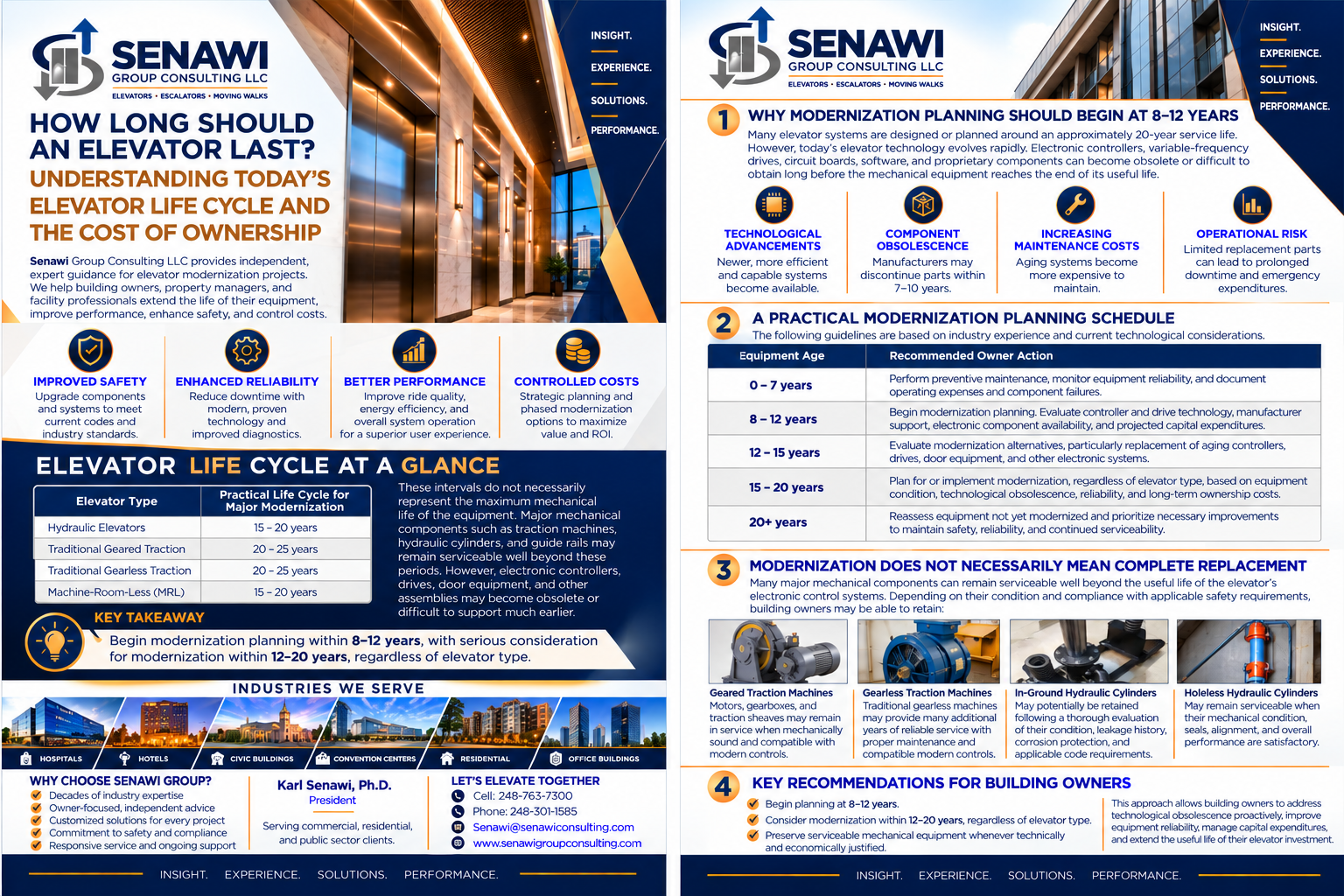
Based on industry experience and published technical guidance, reasonable life-cycle planning intervals are:
- Hydraulic elevators: 15–20 years.
- Traditional geared and gearless traction elevators: 20–25 years.
- Machine-room-less (MRL) elevators: 15–20 years.
These intervals do not necessarily represent the maximum mechanical life of the equipment. Traditional traction machines, hydraulic cylinders, guide rails, and other major mechanical components may remain serviceable well beyond these periods.
However, electronic controllers, motor drives, door equipment, suspension components, and other assemblies may experience deterioration, technological obsolescence, or limited replacement-part availability much earlier.
MRL elevators deserve particular consideration. Although they offer advantages in building space utilization and energy efficiency, certain MRL designs may have shorter practical service lives than traditional traction equipment. Component accessibility, proprietary systems, suspension technology, and replacement costs can significantly affect long-term ownership expenses.
The objective is not to replace an elevator simply because it reaches a certain age, but to anticipate when reliability, maintenance costs, technological obsolescence, and operational risk justify reinvestment.
Why Modernization Planning Should Begin at 8–12 Years
Many elevator systems are designed or planned around an approximately 20-year service life. However, technological advancements and electronic component obsolescence can significantly affect their practical economic life.
Modern elevator systems rely heavily on electronic controllers, variable-frequency drives, circuit boards, software, and proprietary components. These technologies evolve rapidly, and certain components may become obsolete or difficult to obtain long before the mechanical equipment reaches the end of its useful life.
A component does not have to fail to become obsolete. An operational controller or drive may no longer be supported by its manufacturer, creating substantial financial exposure if a critical component subsequently fails.
Building owners should begin modernization planning within 8–12 years of installation, with serious consideration given to modernization within 12–20 years, regardless of whether the elevator is hydraulic, geared traction, gearless traction, or MRL.
The primary drivers are often technological obsolescence, declining manufacturer support, replacement-part availability, increasing maintenance costs, and opportunities to improve reliability and performance.
The following table provides recommended planning guidelines based on industry experience and current technological considerations.
A Practical Modernization Planning Schedule:
§ Age from 0-7 years: Perform preventive maintenance, monitor equipment reliability, and document operating expenses and component failures.
§ Age 8-12 years: Begin modernization planning. Evaluate controller and drive technology, manufacturer support, electronic component availability, and projected capital expenditures.
§ Age 12-15 years: Evaluate modernization alternatives, particularly the potential replacement of aging controllers, drives, door equipment, and other electronic systems.
§ Ages 15-20 years: Plan for or implement modernization, regardless of elevator type, based on equipment condition, technological obsolescence, reliability, and long-term ownership costs.
§ Age 20+ years: Reassess equipment not yet modernized and prioritize improvements necessary to maintain safety, reliability, and continued serviceability.
These time frames are recommended planning guidelines, not mandatory replacement schedules. Actual modernization requirements should be determined through an evaluation of equipment condition, manufacturer support, operational performance, and applicable code requirements.
Modernization Does Not Necessarily Mean Complete Replacement
Many major mechanical components can remain serviceable well beyond the useful life of an elevator's electronic control systems.
Depending on their condition, compatibility with modern technology, and compliance with applicable safety requirements, building owners may be able to retain:
§ Geared traction machines: Including motors, gearboxes, and traction sheaves when mechanically sound and compatible with the proposed modernization.
§ Gearless traction machines: Traditional gearless machines may provide many additional years of reliable service with proper maintenance and compatible modern controls.
§ In-ground hydraulic cylinders: Existing cylinders may potentially be retained following a thorough evaluation of their condition, leakage history, corrosion protection, and applicable code requirements. Concealed conditions and limitations in verifying cylinder integrity must be carefully considered.
§ Holeless hydraulic cylinders: These may remain serviceable when their mechanical condition, seals, alignment, and overall performance are satisfactory.
By retaining serviceable mechanical equipment while upgrading obsolete controllers, motor drives, door systems, and other electrical components, building owners may significantly reduce modernization expenditures compared with complete equipment replacement.
The objective is to modernize the technology without unnecessarily replacing mechanical components that still have substantial remaining useful life.
Key Recommendations for Building Owners
Begin planning at 8–12 years. Consider modernization within 12–20 years. Preserve serviceable mechanical equipment whenever technically and economically justified.
This approach will allows for technological obsolescence proactively, improve equipment reliability, manage capital expenditures, and extend the useful life of their elevator investment.
Elevator technology continues to evolve, and advancements in electronic controls, drive systems, safety features, and equipment design will influence future modernization decisions. Recommendations appropriate today may change as new technologies emerge and existing components become obsolete.
Proactive modernization planning, periodic equipment assessments, and monitoring technological developments are essential to controlling long-term costs and avoiding unexpected capital expenditures.
The most effective strategy is to anticipate technological changes rather than react to equipment failures.